What Changes for Ships and Ports with Circular No. 177/2025 177/2025

Maritime Cyber Risk
The digitalization of navigation has transformed ships and ports into cyber-physical infrastructures. Circular No. 177/2025 — published in December 2025 and entering into force on November 1, 2026 — formally acknowledges this transformation and introduces new requirements for cyber risk management in the maritime sector.
Over the past years, the maritime industry has undergone a significant technological transformation.
Electronic navigation systems, digital fleet management platforms, automated port infrastructures, and interconnected ship-to-shore services have become integral to daily operations. While these technologies improve operational efficiency and safety, they also expose IT/OT environments to new cybersecurity vulnerabilities.
In response to this evolution, the Italian Ministry of Infrastructure and Transport issued the Circular “Navigation Safety – General Series No. 177/2025”, updating security measures for national ships, management companies, and port facilities by introducing specific guidance on Maritime Cyber Risk management.
The document explicitly recognizes that cybersecurity is now a fundamental component of both navigation safety and port infrastructure protection.
Over the past years, the maritime industry has undergone a significant technological transformation.
Electronic navigation systems, digital fleet management platforms, automated port infrastructures, and interconnected ship-to-shore services have become integral to daily operations. While these technologies improve operational efficiency and safety, they also expose IT/OT environments to new cybersecurity vulnerabilities.
In response to this evolution, the Italian Ministry of Infrastructure and Transport issued the Circular “Navigation Safety – General Series No. 177/2025”, updating security measures for national ships, management companies, and port facilities by introducing specific guidance on Maritime Cyber Risk management.
The document explicitly recognizes that cybersecurity is now a fundamental component of both navigation safety and port infrastructure protection.
The document explicitly recognizes that cybersecurity is now a fundamental component of both navigation safety and port infrastructure protection.
Maritime Digitalization and New Attack Surfaces
Modern vessels rely on information systems for several critical functions, including:
- electronic navigation
- propulsion management
- satellite communications
- cargo management
- operational performance monitoring
At the same time, port infrastructures have evolved into highly digitalized environments, with platforms dedicated to maritime traffic management, container logistics, and the coordination of port operations.
The growing integration between Information Technology (IT) and Operational Technology (OT) has significantly expanded the cyber attack surface, requiring a more structured approach to cybersecurity.
What Circular 177/2025 Introduces
The circular introduces a more structured framework for cyber risk management within the maritime sector.
The new measures apply to:
- ships flying the Italian flag
- ISM management companies
- port facility operators
- competent maritime authorities
The objective is to integrate cyber risk management into existing security processes already established by international regulatory frameworks.
Integrating Cyber Risk into Maritime Security Systems
One of the key elements introduced by the circular is the integration of cyber risk within maritime safety and security management systems.
This includes:
- updating Safety Management Systems (SMS)
- integrating cybersecurity into port security plans
- introducing cyber incident management procedures
In particular, port facility operators will need to update documentation required by the ISPS Code, including:
- PFSA – Port Facility Security Assessment
- PFSP – Port Facility Security Plan
These documents must now include dedicated cyber risk assessments.
Assessment of Critical Systems
The circular places particular emphasis on digital systems that may directly affect navigation safety or the operational continuity of port infrastructures.
These include:
- ship propulsion and steering systems
- energy management systems
- electronic navigation platforms
- ship-to-shore communications
- port digital infrastructures
- maritime traffic services
Such systems must undergo periodic risk assessments and be protected through appropriate security measures.
Naval OT: Critical Onboard Systems
Modern vessels include several Operational Technology (OT) components that are essential for navigation and vessel operations.
These include:
ECDIS – Electronic Chart Display and Information System
An electronic navigation system that replaces traditional nautical charts.
AIS – Automatic Identification System
A system that enables ships to identify one another and share positional data.
Integrated Bridge Systems (IBS)
Integrated platforms that consolidate data from radar systems, sensors, and navigation equipment.
Engine Control Systems
Industrial systems responsible for managing propulsion, engines, and onboard power distribution.
Cargo Management Systems
Platforms used to monitor and control cargo loading and unloading operations.
A compromise of these systems could directly impact vessel safety and the continuity of maritime operations.
OT in Port Infrastructures
Similarly, port infrastructures rely on OT systems comparable to those used in industrial environments.
Among the most relevant systems are:
- container terminal automation systems
- port crane management systems
- maritime traffic management systems (VTS – Vessel Traffic Services)
- energy management systems
- logistics and port operations coordination platforms
These systems are often interconnected with corporate IT networks and external platforms, creating complex technological environments that require dedicated cybersecurity strategies.
Attack Surfaces in Port Infrastructures
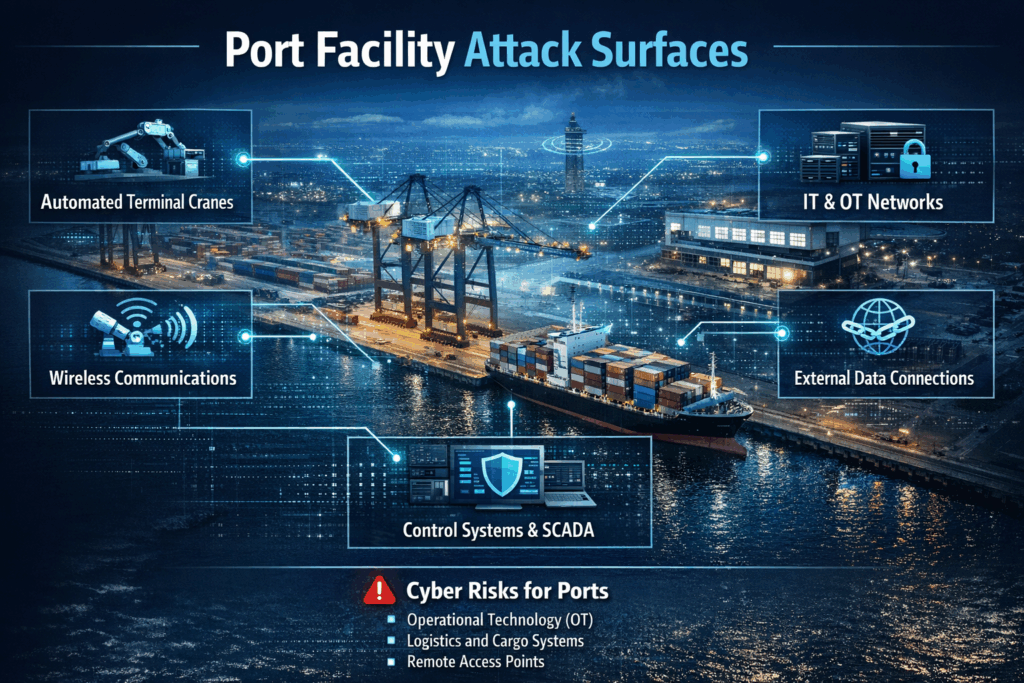
Port infrastructures represent one of the most critical nodes in global supply chains. Increasing automation and digital interconnectivity expose several potential attack surfaces, including:
- automated container terminals
- port crane management systems
- maritime traffic management systems (VTS)
- port energy infrastructures
- IT networks and connections with external operators
Attack Surface of a Modern Ship

A modern vessel can be considered a complex cyber-physical system.
Key cyber exposure points include:
- ECDIS navigation systems
- satellite communications
- onboard IT systems
- AIS
- engine control systems
- cargo management platforms
Alignment with the European NIS2 Directive
These new provisions are part of a broader European regulatory framework.
With the adoption of the NIS2 Directive, many maritime sector organizations fall within the scope of entities required to implement advanced cybersecurity measures and report significant incidents.
This further reinforces the importance of cybersecurity for:
- ports
- shipping companies
- logistics operators
- critical infrastructures
Cybersecurity Challenges in the Maritime Sector
The implementation of these measures introduces several operational challenges.
Among the most relevant are:
Protection of maritime OT systems
Many onboard industrial systems were not originally designed with advanced cybersecurity requirements.
Management of complex IT/OT environments
Maritime organizations must manage hybrid infrastructures that combine legacy systems with modern digital platforms.
Continuous monitoring of critical infrastructures
The ability to detect anomalous activity is essential to prevent operational disruptions
Protection of the maritime supply chain
Ports and shipping companies represent key nodes within global logistics networks.
Agger Naval Cyber Resilience: How Gyala Supports Cybersecurity in the Maritime Sector
Protecting maritime infrastructures requires tools capable of monitoring complex environments where IT systems, industrial networks, and operational platforms coexist.
In the naval and port sectors, the main challenges include:
- limited visibility into OT systems
- the presence of legacy systems that are difficult to update
- increasing interconnection between operational networks and IT systems
- the need to detect operational anomalies in real time
Gyala’s approach is based on advanced monitoring and anomaly detection platforms designed specifically for critical infrastructures and already deployed in maritime and port environments.
These solutions enable organizations to:
- continuously monitor IT and OT networks
- detect anomalous activities and potential compromises
- increase visibility across operational infrastructures
- support incident management through advanced and customizable detection and response capabilities
Applied to the maritime sector, these capabilities strengthen the protection of:
- port infrastructures
- onboard digital systems
logistics terminals
fleet management platforms
At Gyala, we have deep expertise in the maritime sector.
We are not adapting a generic technology to ships — our solution was designed and developed specifically for this industry. - logistics terminals
- fleet management platforms
At Gyala, we have deep expertise in the maritime sector.
We are not adapting a generic technology to ships — our solution was designed and developed specifically for this industry: Agger Naval Cyber Resilience.

